Neuro-like Temporal Learning Systems
How does a brain build a faithful model of the world from limited experience? Sensory input is finite and working memory is bounded, so rare events are sampled far more sparsely than common ones, and a model learned under these conditions inherits biased priors. In collaboration with KTH, I study this with a Bayesian Confidence Propagation Neural Network (BCPNN), a brain-like attractor network with a modular hypercolumn architecture, trained on event sequences from a Markov world with controlled probabilities. Trained on limited samples, the network systematically over- or under-estimates rare events. Injecting a moderate amount of noise into its internal simulation corrects both the unconditional and the transition statistics, and widens the parameter regime in which the internal model stays accurate. The result points to stochastic “mental simulation” as a mechanism by which the brain compensates for biased experience, with neural noise as intrinsic variability and tonic neuromodulation as the control over how fast priors update and how strongly they bias replay.
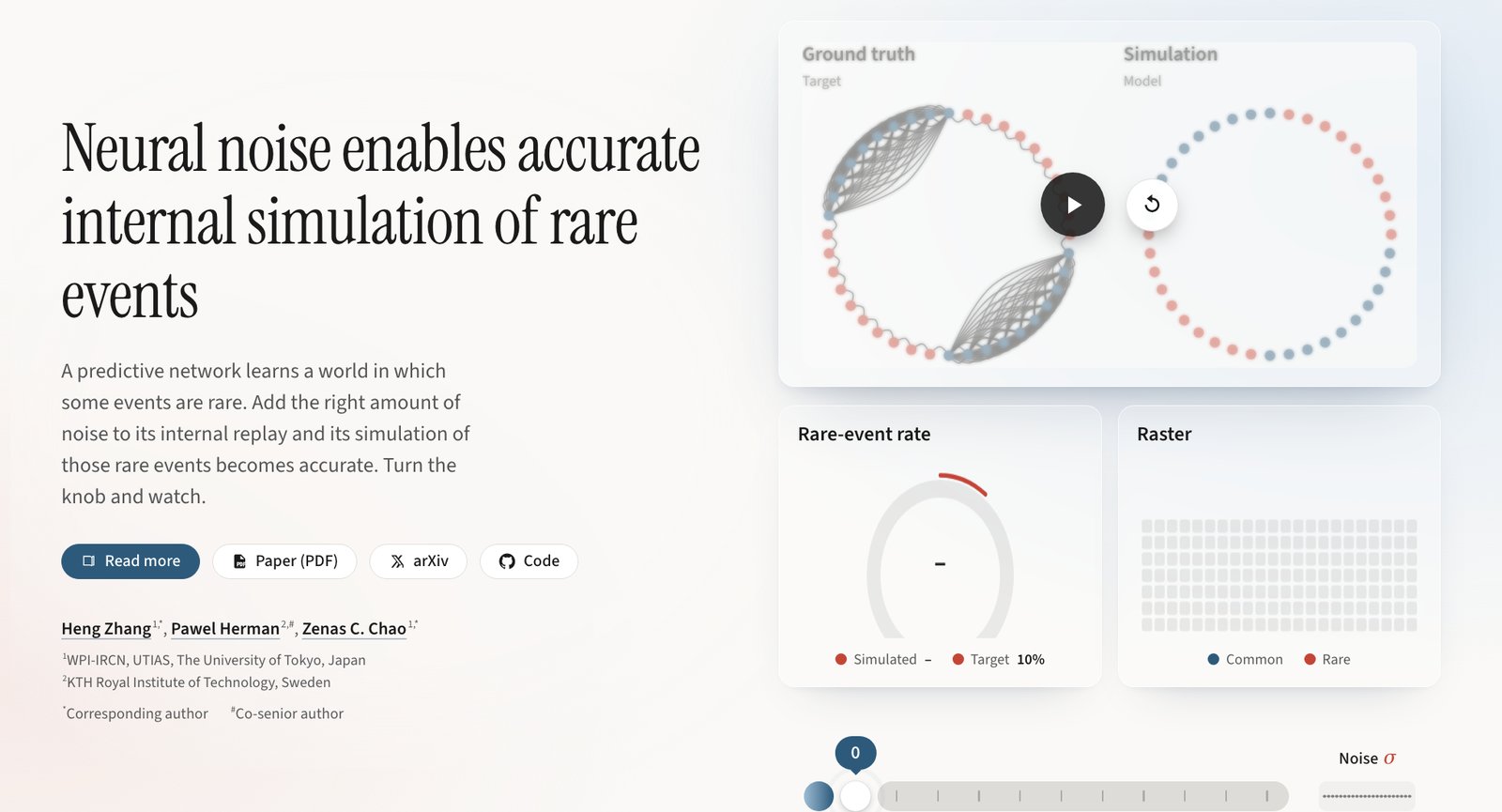 Open the interactive companion site ↗
Run the model in your browser: turn the noise knob and watch the simulated rare-event rate approach the target.